Bd Botreau Roussel, Abidjan Plateau Regulation · Stabilisation · Development
Projects

Swollen Shoot

Programme to fight cocoa swollen shoot disease

A viral disease spread by mealybugs, swollen shoot threatens the sustainability of Ivorian cocoa farming. In 2018 the Coffee and Cocoa Council launched a programme to step up the fight: uprooting infected plots, replanting, support for farmers and research.

Background

For more than forty years, Côte d’Ivoire has been the world’s leading cocoa producer, with over 40% of the market. Cocoa accounts for more than 30% of export earnings and more than 15% of GDP.

Production under pressure

Cocoa farming faces ageing orchards and farmers, pests, new threats such as stem borers and Phytophthora megakarya, and swollen shoot.

An old disease that has become virulent

The first outbreaks were reported in 1943 in the east of the country. From 2003, the CNRA confirmed virulent forms in the heart of the production areas, notably in Bouaflé and Sinfra. The disease, spread by mealybugs, is endemic in Côte d’Ivoire, Ghana and Togo.

From pilot project to intensification programme

After the first control projects (2008), a national programme (2009) and a pilot uprooting and replanting project (2011-2012), the Council launched the five-year programme to intensify the fight against swollen shoot in Bouaflé on 23 January 2018.

Recognising the disease in the orchard

Research has identified five symptoms.

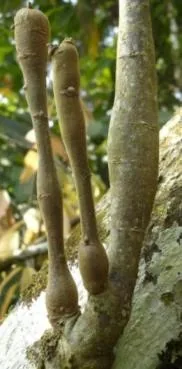
Swollen shoots

Swollen shoots

Typical sign: swellings on the stems, especially on chupons.

Swollen roots

Swollen roots

Swellings on the taproot or on the lateral roots.

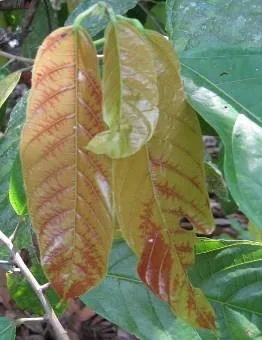
Red veins

Red veins

On young leaves, dark red bands along the veins.

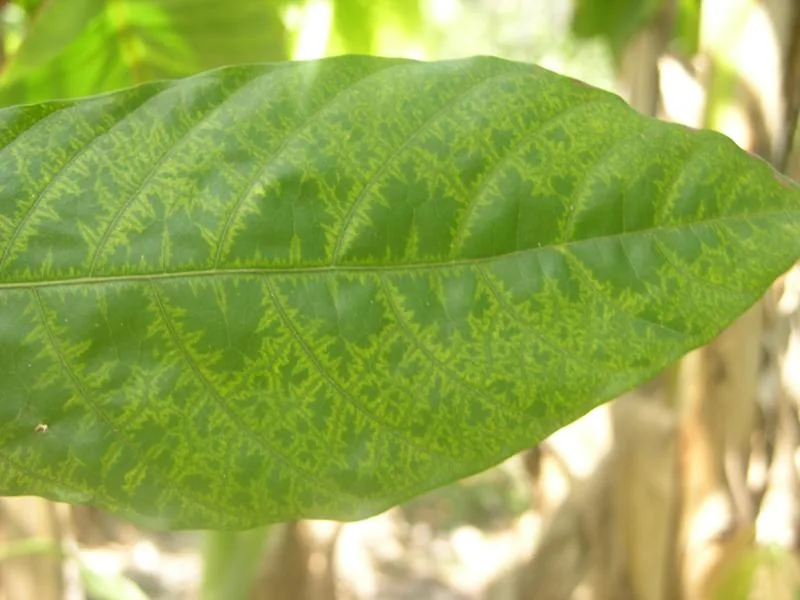
Yellow patches

Yellow patches

On mature leaves, yellow mosaic patches along the veins.

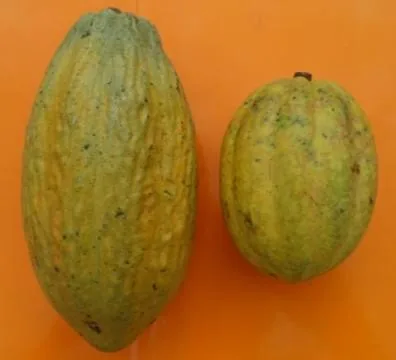
Stunted pods

Stunted pods

Small, misshapen pods and smaller beans. To be confirmed: other causes exist.

The damage caused by swollen shoot

Weed invasion, defoliation, drying branches and finally the death of the trees.

−25 %yield in the first year
−50 %yield in the second year
3 to 5 yearsbefore the cocoa tree dies

Regulatory framework

2013

Decree No. 2013-852

Of 19 December 2013, on protecting cocoa trees against swollen shoot.

2016

Order No. 584

Of 15 September 2016: creation and operation of the swollen shoot control brigades.

2016

Order No. 585

Of 15 September 2016: procedure for uprooting infected cocoa trees and terms of replanting aid.

II · 2018-2022 programme

The programme’s objectives

Stop the spread of the disease and replant all infected areas: three years of intensive uprooting, then two years of inspection of the whole orchard and the borders.

100 000 haof infected plantations to uproot
9 % → 0 %target prevalence rate
21 bn CFA francsoverall budget
5 yearsof implementation (2018-2023)

Six components

1. Information and training

Local radio, village meetings and demonstration plots to train farmers.

2. Mapping outbreaks

Identify, map and measure all infected plots (ANADER).

3. Uprooting

Uprooting of 100,000 ha by operators recruited by the Council and ANADER.

4. Support measures

Support of CFA 40,000 per hectare uprooted, 5 litres of inputs per hectare and an incentive of CFA 50,000 per hectare.

5. Monitoring

Regular inspections, monitoring of replanting and borders, monitoring brigades.

6. Research

Understand the virus, its vectors and host plants; find tolerant varieties.

III · Research results

The swollen shoot programme in figures

6hybrids free of symptoms 8 years after planting
480farmer accessions introduced into the greenhouse
05viral strains characterised (B, D, E, F, BC)
9mealybug species collected, 7 of them vectors
24host plant species identified
6tolerant CNRA varieties

Infected areas uprooted

Hectares uprooted per period (as at 30 June 2020).

010,00020,00030,00040,000ha2014-2017 plancontract2014-2017 plan contract : 16,350 ha16,3502017 interimphase2017 interim phase : 5,518 ha5,5182018-2019season2018-2019 season : 30,295 ha30,294.62019-2020season2019-2020 season : 37,294 ha37,294
See the data
ha
2014-2017 plan contract16,350 ha
2017 interim phase5,518 ha
2018-2019 season30,294.6 ha
2019-2020 season37,294 ha

Results of the intensification phase

67 588 hauprooted in total
150 935farmers made aware and trained (8% women)
6 958localities reached
53local radio stations involved

Conclusion and outlook

The outlook is good overall. The third uprooting season began on 1 July 2020 and runs until 30 June 2021. About 60,000 ha of outbreaks then remained to be treated.